
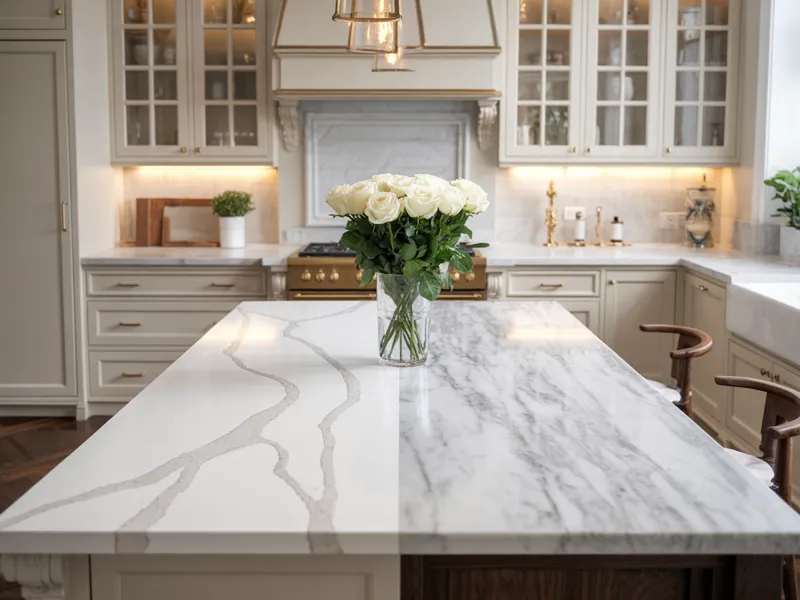
Quartz vs Marble Countertops: Which Is Right for Your Home?

In the quartz vs marble decision, quartz wins on everyday practicality and marble wins on natural character. Quartz is an engineered surface that is non-porous, doesn't need sealing and doesn't etch. Marble is a natural stone with veining no factory can fully copy, but it etches, stains more easily and needs regular care.
I've fabricated both over more than 20 years, and the right answer really depends on how you use your kitchen or bath. This guide compares quartz vs marble countertops on the points that matter in daily life, then covers the option many South Florida homeowners end up choosing: marble-look quartz. For the basics of how quartz is made, start with our guide to what quartz countertops are.
Quartz vs Marble: The Short Comparison
| Factor | Quartz | Marble |
|---|---|---|
| What it is | Engineered: crushed quartz bound with resin and pigments | Natural stone, mainly calcium carbonate |
| Sealing | Not needed | Needed, and repeated over time |
| Etching from acids | Does not etch | Etches from lemon, vinegar, wine and similar |
| Staining | Highly stain resistant | Can stain if not sealed and wiped promptly |
| Scratches | Resists everyday scratches | Softer, scratches more easily |
| Heat | Heat resistant, not heat proof; use trivets | Natural stone, but still best protected with trivets |
| Look | Consistent, designed pattern | One-of-a-kind natural veining |
| Aging | Stays close to new | Develops a worn patina |
How Marble and Quartz Countertops Are Made
Marble forms when limestone is changed by heat and pressure deep in the earth. It's a calcareous stone, made mainly of calcium carbonate, which is why it reacts with acids. Each slab is cut from a quarried block, so its veining and color belong to that slab alone.
Quartz countertops are engineered. Manufacturers blend ground quartz with resins and pigments, press the mix into slabs and cure them. That process makes a dense, non-porous surface, and it lets designers create patterns, including marble looks, that stay consistent from slab to slab.
Durability: Marble vs Quartz in Daily Use
Etching
Etching is the biggest practical difference. When an acid such as lemon juice, vinegar, tomato sauce, wine or some cleaners touches marble, it dissolves a thin layer of the surface and leaves a dull spot. Sealer doesn't stop this, because the acid reacts with the stone itself. On a polished marble kitchen counter, etch marks show up quickly around the cooktop and sink. Quartz doesn't react with household acids this way.
Stains
Marble is porous, so oil, coffee and wine can soak in if they sit. Sealing slows this down but doesn't make marble stain-proof. Quartz is non-porous, so most spills wipe off. Our guide to cleaning quartz countertops covers the few things to avoid on quartz.
Scratches and chips
Marble is a relatively soft stone and scratches more easily than quartz. Both can chip on a hard knock at an edge or corner, which is one reason a rounded edge profile is popular on busy islands.
Heat
Neither surface should be used as a trivet. Quartz manufacturers call their material heat resistant, not heat proof, and ask you to use trivets or hot pads. Marble is best protected the same way. Our guide to whether quartz is heat resistant explains what the manufacturers recommend.
Maintenance: Quartz vs Marble Countertops Over the Years
Quartz care is simple: warm water, mild dish soap and a soft cloth. No sealing, ever.
Marble needs more routine care:
- Seal it regularly; how often depends on the stone and how it's used
- Use pH-neutral cleaners made for stone, not vinegar or acidic sprays
- Wipe up acidic spills right away
- Accept that etching will happen, or plan for periodic professional refinishing
Some people like the lived-in look marble develops. Others find every dull ring a frustration. Knowing which camp you're in is most of the decision.
Appearance: Why People Still Choose Marble
Real marble has depth. Light moves into the stone and back out, and the veining never repeats. For a formal kitchen, a powder room or a bar that gets light use, that character is the reason to choose it.
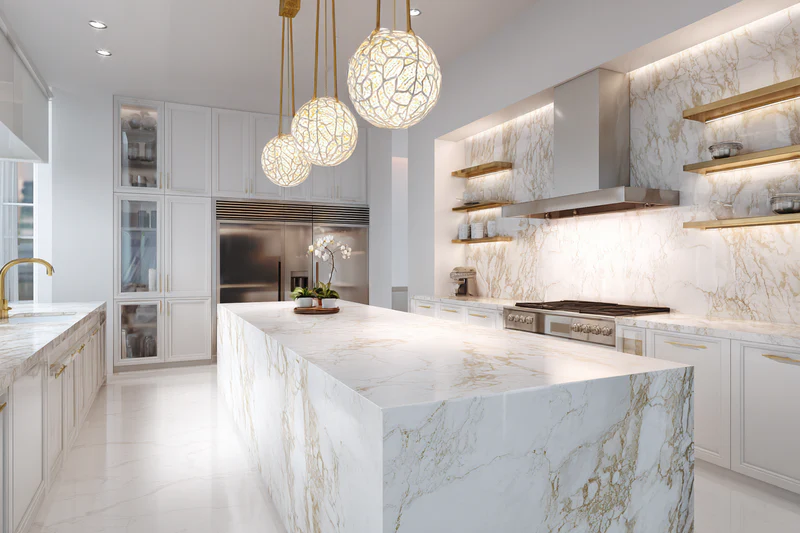
Quartz can't copy every quality of natural stone, but modern marble-look designs have come a long way. Veins now run through the body of many slabs, not only on the surface, and patterns are scaled to look natural across an island. Designs such as Cambria Brittanicca give a bold Calacatta-style look without the sealing or etching. Our guide to quartz that looks like marble compares the most realistic options by brand.
Quartz vs Marble Cost: What Drives the Price
Is marble more expensive than quartz? Sometimes. The price of both depends on the specific stone or color, the slab count, thickness, edges, cutouts and installation conditions.
- Marble ranges from widely quarried stones to rare Calacatta and Statuario, which sit at the top of the market. You also pay for sealing and upkeep over the years.
- Quartz is priced in tiers by brand and design. Bold marble-look veining usually sits in the higher tiers.
Fabrication is broadly similar. With marble, pattern matching across seams can add layout time, and soft stone needs careful handling. For how quartz pricing works, see our quartz countertops cost guide, or get an instant figure from our quote calculator.
Quartz vs Marble for a Bathroom or Kitchen in South Florida
Kitchens. Florida kitchens see a lot of citrus, cooking and entertaining. Quartz handles that with less upkeep, which is why it's the more common choice for busy family kitchens and rentals.
Bathrooms. A vanity sees less acid and heat, so marble is more forgiving there. Toothpaste, cosmetics and some cleaners can still etch it, and a humid bathroom doesn't change that. For a low-maintenance family bath, quartz is the easier option. See our bathroom vanity countertops for examples.
Condos and rentals. In Miami Beach and other coastal condos that are rented part of the year, owners often choose quartz because guests won't treat marble gently.
Which Should You Choose?
Choose marble if you want natural stone with one-of-a-kind veining, you're willing to seal and clean it carefully, and you're comfortable with the patina it develops.
Choose quartz if you want a marble look with minimal upkeep, a surface that doesn't etch or need sealing, and a pattern you can choose from a sample.
For the other natural stone comparisons, read quartz vs granite and quartz vs quartzite. When you're ready, browse our quartz countertops and book a free in-home estimate.
Frequently Asked Questions
Is quartz or marble better for a kitchen?
For most kitchens, quartz is the more practical choice. It is non-porous, does not need sealing and does not etch when acids such as lemon juice or vinegar touch it. Marble is a natural stone that etches and stains more easily and needs sealing and careful cleaning. Marble suits owners who love natural stone and accept the wear it shows over time.
Is marble more expensive than quartz?
It depends on the stone and the quartz color. Common marbles can be priced close to many quartz colors, while rare Calacatta and Statuario marbles are among the most expensive countertop materials. Fabrication costs are similar; marble adds ongoing care such as sealing. A quote for your layout is the only way to compare accurately.
Can you tell the difference between quartz and marble?
Up close, usually yes. Natural marble has depth and veining that never repeats, while marble-look quartz uses a designed pattern, and some designs repeat across slabs. From across a room, well-made marble-look quartz can be hard to tell apart, which is why it is popular.
Is quartz or marble better for a bathroom?
Both work in bathrooms, where there is less acid and heat than in a kitchen. Marble is a long-standing choice for vanities, but it can still etch from toothpaste, cosmetics and some cleaners. Quartz is the lower-maintenance option for a busy family bathroom.
Does marble need to be sealed?
Yes. Marble is porous, so it is typically sealed to help it resist stains, and resealed from time to time. Sealing does not prevent etching, which is a chemical reaction between acids and the stone itself. Quartz does not need to be sealed.
Compare Marble-Look Quartz in Person
The best way to decide is to see the materials side by side. Visit our Boca Raton showroom to compare marble-look quartz colors, or book a free in-home estimate and we will bring samples to your kitchen. We serve Palm Beach, Broward and Miami-Dade counties.
Book a Free Estimate