
Quartz Countertop Overhang and Support

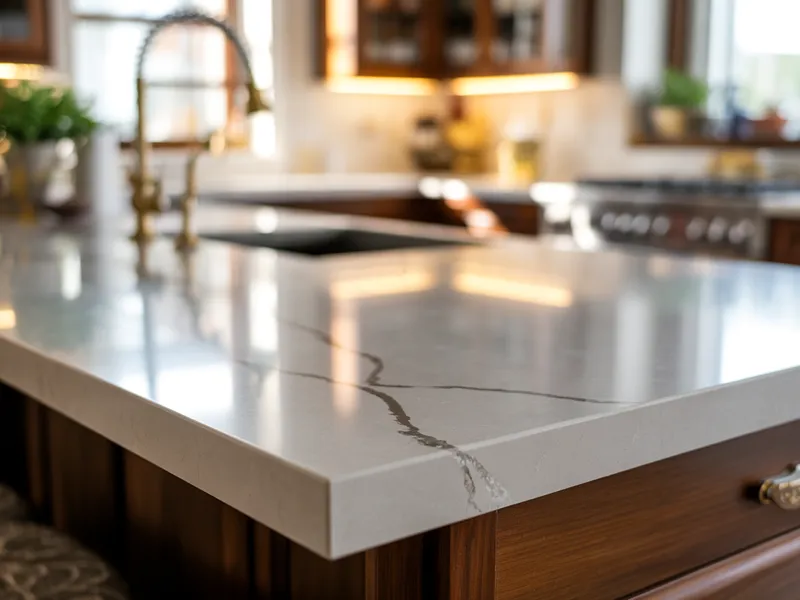
A quartz countertop overhang is the part of the top that extends past the cabinet below it. A standard front overhang is small, about 1½ inches, and needs no extra support. Seating overhangs are much deeper, and once they pass roughly 12 to 15 inches (the exact limit depends on the brand and on 2 cm or 3 cm thickness), manufacturers call for corbels, brackets, steel or legs.
This guide covers the numbers the quartz manufacturers publish, how deep a seating overhang should be for comfort, and the support options that keep the stone from cracking. For the full installation process, see our quartz countertop installation guide.
What Is the Standard Countertop Overhang?
Most base cabinets are about 24 inches deep, and most kitchen countertops are cut about 25 to 25½ inches deep. That leaves a front overhang of roughly 1 to 1½ inches past the cabinet face. Caesarstone describes 1½ inches as the standard quartz countertop overhang.
That small lip does real work. It keeps drips off the cabinet doors, gives the edge profile room to show, and clears the drawer fronts and hardware. Where a counter meets a range or a refrigerator, the fabricator also sets the overhang so the edge lines up with the appliance.
Side overhangs at the end of a run are usually the same 1 to 1½ inches. None of these small overhangs need added support, because almost the entire slab is sitting on cabinet.
How Much Overhang for Countertop Seating?
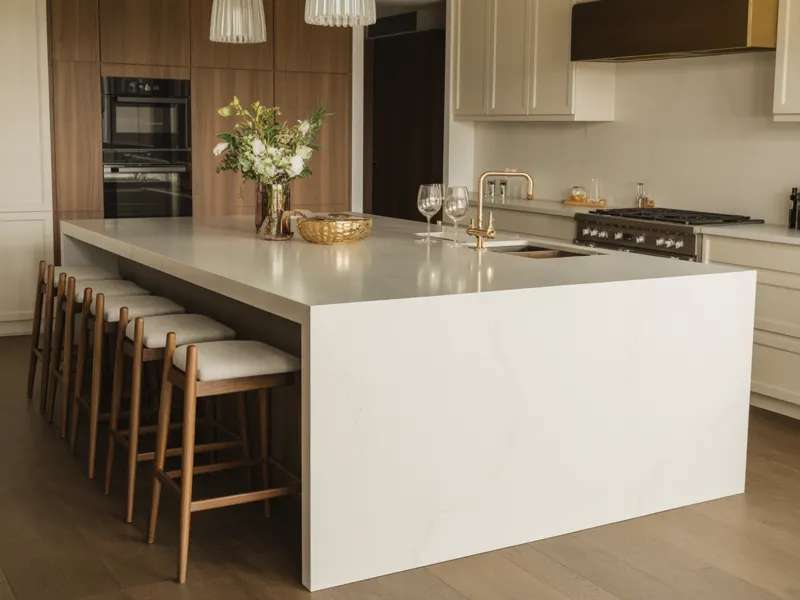
Seating is where overhangs get deep. The National Kitchen & Bath Association (NKBA) planning guidelines give knee-space depths by counter height, with 24 inches of width per seat:
| Counter height | Knee space per seat (NKBA) |
|---|---|
| 30 in (table height) | 24 in wide × 18 in deep |
| 36 in (standard counter height) | 24 in wide × 15 in deep |
| 42 in (bar height) | 24 in wide × 12 in deep |
Knee space is not always the same as overhang. If the seating side of an island has shallow cabinets or an open panel set back from the edge, part of the knee space comes from that recess. On a standard island, though, the overhang provides it, which is why 12 inches is the common island overhang and 15 inches is the comfortable target at 36-inch counter height.
Deeper overhangs are more comfortable, but they are also where support rules start to apply.
How Far Can Quartz Overhang Without Support?
There is no single industry number. Each quartz manufacturer publishes its own limits, and they differ by thickness. Here is what three major brands say in their own guidance.
Cambria
Cambria's countertop installation technical guideline says any overhang over 12 inches in 2 cm, or over 15 inches in 3 cm, needs additional structural support such as corbels or structural steel, placed at most every 36 inches on center. Overhangs over 18 inches (2 cm) or 24 inches (3 cm) need a full substrate plus vertical supports every 36 inches. Cambria also limits the overhang, even with corbels, to no more than one third of the depth of the base cabinet, and requires support within 3 inches of any cutout.
Caesarstone
Caesarstone's guidance says a quartz overhang should be no more than one third of the countertop depth and should not exceed 15 inches, and that about 70% of the countertop needs to be supported. Where a design calls for more, it describes corbels for overhangs from about 15 to 24 inches, spaced no more than 3 feet apart, and posts or a substrate beyond 24 inches. For 2 cm tops, Caesarstone says to add plywood under any overhang over 8 inches.
Silestone
Cosentino's Silestone installation manual sets limits by thickness and by the shape of the overhang (one side, L-shaped, U-shaped or between supports), and requires the supported part of the top to be at least twice as deep as the overhang in the simple cases. It also halves the allowed overhang for a short list of colors. That is a good reminder that the color, not just the brand, can change the answer.
Countertop Overhang Support Options
When an overhang goes past the manufacturer's limit, there are four common ways to support it. Your fabricator will usually recommend one based on the look you want and how much legroom you need.
- Corbels: decorative wood or metal brackets fixed to the island's side. They suit traditional kitchens but take up some knee space.
- Hidden steel brackets: flat steel plates or L-brackets mounted on top of or behind the cabinets, under the stone. Many homeowners pick these for a clean, floating look with open legroom.
- Legs and posts: needed for very deep overhangs and tabletop-style extensions. Brands like Cambria require vertical support every 36 inches beyond their substrate limits.
- Full substrate: plywood or another rigid layer under the whole overhang, which spreads the load and is required by some brands for deeper or thinner tops.
Whatever the method, the support has to be in place and level before the stone arrives. Cambria's guideline says the support structure must carry the countertop without deflection and must not be out of plane by more than 1/8 inch over 8 feet.
Why Quartz Overhangs Crack
Quartz is strong in compression but can crack when it is bent. Nearly every overhang failure comes from one of these:
- Too little support for the depth. Someone sits on the edge or leans on it, and the unsupported stone flexes at the cabinet line.
- A cutout near the overhang. A sink or cooktop opening close to the cabinet edge removes material exactly where the stone is under the most stress.
- A seam in the overhang. Cambria requires field seams to be fully supported, including in overhang areas. See our guide to quartz countertop seams for where seams belong.
- Uneven cabinets. If the island is out of level, the stone is not sitting evenly, and the overhang carries loads it was not designed for.
Warranty coverage is the manufacturer's, not the installer's, and it depends on the manufacturer's terms. Following the brand's support guidance is part of protecting it.
Planning an Island Overhang in South Florida Homes
Many South Florida kitchens are being opened up, especially in older ranch homes and in condos where a wall comes down to create an island. A few local points come up often:
- Condo islands are often shallow. In a tight condo kitchen, a 12-inch overhang may be all the walkway allows. Check the aisle width before you add depth.
- Associations may review the plan. Structural steel or new cabinetry can be part of the scope a condo association wants to see. Our condo countertop installation guide covers approvals.
- Outdoor islands need outdoor-rated supports. Salt air corrodes plain steel. If you are building a bar on a lanai, see our outdoor countertops page first.
Supports are planned at the templating visit, when the fabricator measures the island and confirms where brackets or corbels will go. You can get a starting estimate for an island with our quote calculator, and browse finished islands on our kitchen and bath countertops page.
Frequently Asked Questions
What is the standard countertop overhang?
The standard front overhang on a kitchen countertop is about 1 to 1½ inches past the cabinet face, and Caesarstone lists 1½ inches as standard for quartz. This small overhang needs no added support.
How far can quartz overhang without support?
It depends on the brand and thickness. Cambria requires added support beyond 12 inches for 2 cm and 15 inches for 3 cm. Caesarstone says an overhang should be no more than one third of the countertop depth and not over 15 inches, and recommends plywood under 2 cm overhangs over 8 inches. Always check the guidance for your specific brand and color.
How much overhang do you need for countertop seating?
NKBA planning guidelines call for 15 inches of knee space at a 36-inch counter, 12 inches at a 42-inch bar and 18 inches at a 30-inch table, with 24 inches of width per seat. A 12-inch island overhang is common, and 15 inches is more comfortable at counter height.
Do quartz countertops need brackets or corbels?
Only when the overhang is deeper than the manufacturer allows without support. For deeper seating overhangs, fabricators use corbels, hidden steel brackets, legs or a full substrate, spaced at the intervals the brand specifies, such as every 36 inches for Cambria.
Can a quartz overhang crack?
Yes. Quartz can crack when an overhang is deeper than its support allows, when a cutout or seam sits in the overhang, or when the cabinets below are out of level. Following the manufacturer's support guidance prevents most of these failures.
Planning an Island With Seating?
Bring your layout and the brand you like to a free in-home estimate. We will measure the overhang you want, check it against that manufacturer's support guidance and show you where supports would go before anything is cut. We serve Palm Beach, Broward and Miami-Dade counties. Call (720) 324-1436 or request an estimate online.
Request a Free Estimate