
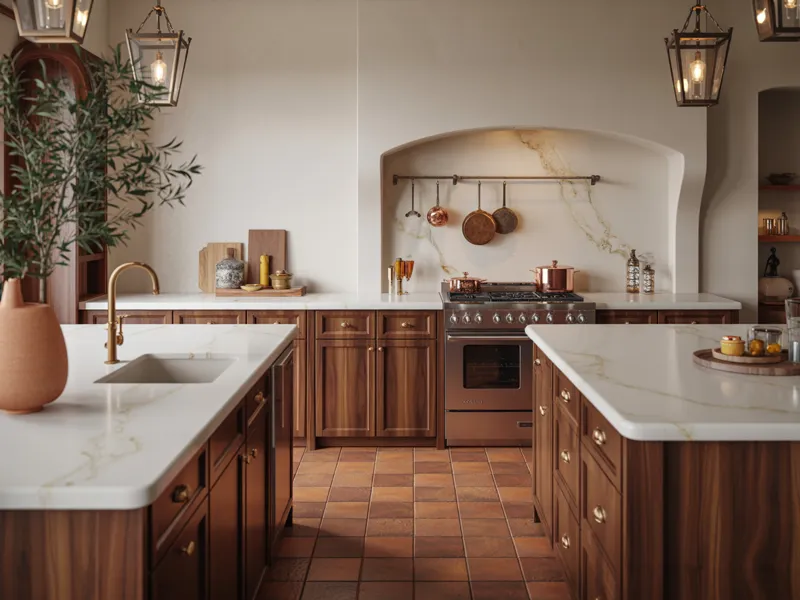
Installing Quartz on Existing Cabinets

Yes, you can replace countertops without replacing cabinets, and installing quartz on existing cabinets is one of the most common kitchen upgrades. It works when the cabinet boxes are structurally sound, close to level, fastened together and to the wall, and free of water damage. Loose, sagging or rotted boxes need repair first, because quartz is heavy and has almost no tolerance for flex.
This guide covers the checks that decide whether your cabinets are ready, what can be fixed on the spot, and what to plan for when the old tops come off. For the rest of the process, see our quartz countertop installation guide.
Can You Put New Quartz Countertops on Old Cabinets?
In most kitchens, yes. Quartz does not need special cabinets. It needs a flat, level, rigid base. Standard framed and frameless cabinets both work, and the age of the cabinets matters much less than their condition.
Keeping your cabinets makes sense when:
- You like the layout and do not plan to move the sink, range or dishwasher
- The boxes are plywood or solid particleboard with no swelling
- Doors and drawers can be refinished, repainted or refaced if you want a new look
It makes less sense if you are changing the layout, adding an island, or the sink base has years of water damage. In those cases it is cheaper to fix the base now than after the stone is on.
How Much Quartz Countertops Weigh
Quartz weight per square foot comes straight from the manufacturers. Cambria lists about 10 lb per square foot at 2 cm and 15 lb per square foot at 3 cm. Caesarstone lists 66 to 70 kg per square meter at 3 cm, roughly 13.5 to 14.5 lb per square foot.
A 10-foot run of standard-depth 3 cm quartz is about 21 square feet, so it weighs roughly 300 lb before you add a sink full of water. Sound cabinets carry that easily because the load is spread across every side panel. Weak ones show it as sagging, doors that stop closing or gaps at the wall. Our guide to quartz slab sizes has full slab weights by brand.
What to Check Before Installing Quartz on Existing Cabinets
1. Structure
Press down on the top of each cabinet and rock it. The boxes should not move, creak or shift away from each other. Look for side panels that bow, missing back rails and screws pulled loose from the wall.
2. Level and Flatness
Quartz should sit flat on every cabinet. Installers shim small differences, which is routine. Large differences, such as a floor that drops an inch across the kitchen, may need the cabinets reset before templating. Cosentino's Silestone manual asks that cabinets be installed, leveled and in their final position before measurements are taken, and Cambria's guideline says the support structure must not be out of plane by more than 1/8 inch over 8 feet.
3. The Sink Base
The sink cabinet takes the most abuse. Check the floor of the cabinet and the side panels for swelling, soft spots, stains or a musty smell. Undermount sinks hang from the quartz, but the cabinet still needs to be solid around the opening. If the floor of the sink base is damaged, replace it before the new top goes on.
4. Depth and Overhang
Most base cabinets are about 24 inches deep, and new tops are usually cut to leave a 1 to 1½ inch front overhang. If your existing cabinets are shallower or deeper, the fabricator adjusts. If you are adding a seating overhang, check the manufacturer's support limits in our guide to quartz countertop overhang and support.
5. Plywood and Substrate
Many kitchens with laminate or tile tops have a plywood deck under them. For 3 cm quartz, Caesarstone says no additional support is needed, and it recommends plywood for 2 cm tops only where an overhang is over 8 inches. Your fabricator will decide whether to keep an existing deck or remove it, since leaving it raises the counter height.
Common Fixes Before New Quartz Goes On
Most issues with existing cabinets are small and handled before or during installation:
- Shimming to level the tops of the boxes
- Adding corner blocks or rails where a box is missing support at the top
- Re-fastening loose boxes to each other and to the wall studs
- Replacing a sink base floor that has water damage
- Adding support across wide openings, such as a dishwasher gap or an open shelf
Bigger structural problems, like a cabinet that has pulled away from a failing wall or rot that has spread, are usually a job for a cabinet installer before templating.
What Happens to Cabinets When the Old Tops Come Off
Removal is where existing cabinets are most at risk. Stone and tile tops are bonded down, and prying them loose can crack a face frame or lift a cabinet top. Laminate is usually screwed up from inside the boxes. A careful crew protects the cabinet faces, cuts adhesive instead of forcing it and checks the boxes again once the top is off. Our guide to countertop removal and replacement walks through that step in detail.
Expect some touch-up. The top edge of a cabinet that was hidden under the old counter may have gaps, old caulk or paint lines. If you plan to repaint the cabinets anyway, schedule it after installation.
Older South Florida Kitchens
Many homes across Palm Beach and Broward counties, including older neighborhoods in Boca Raton, still have original cabinets under tile or laminate tops. Plenty of those boxes are solid and good candidates for quartz. The ones to watch are sink bases with long-term leak damage and cabinets in homes with settled floors. A quick look at the estimate tells you which you have.
To price new quartz on your current cabinets, try our quote calculator or see our kitchen and bath countertops page.
Frequently Asked Questions
Can you replace countertops without replacing cabinets?
Yes. As long as the cabinet boxes are structurally sound, close to level, fastened together and free of water damage, new quartz countertops can go on existing cabinets. Small issues are fixed with shims and added supports.
Can old cabinets support the weight of quartz?
Sound cabinets can. Cambria lists 3 cm quartz at about 15 lb per square foot, so a 10-foot run is roughly 300 lb spread across every side panel. Cabinets that sag, rock or have water damage need repair before quartz goes on.
Do you need plywood under quartz countertops?
Usually not for 3 cm quartz, which Caesarstone says needs no additional support. Caesarstone recommends plywood under 2 cm quartz only where an overhang is over 8 inches. Your fabricator decides whether to keep an existing plywood deck.
Will removing old countertops damage my cabinets?
It can if the old tops are forced off. A careful crew protects the cabinet faces, cuts adhesive rather than prying, and checks the boxes once the tops are off. Some touch-up along the top edges is normal.
Do cabinets need to be level for quartz?
Yes. Quartz needs a flat, level base, and installers shim small differences as routine. Cambria sets a limit of 1/8 inch out of plane over 8 feet for the support structure.
Not Sure Your Cabinets Are Ready?
Book a free in-home estimate and we will look at your cabinets before you commit: level, sink base, depth and anything that should be fixed first. We serve Palm Beach, Broward and Miami-Dade counties. Call (720) 324-1436 or request an estimate online.
Request a Free Estimate