
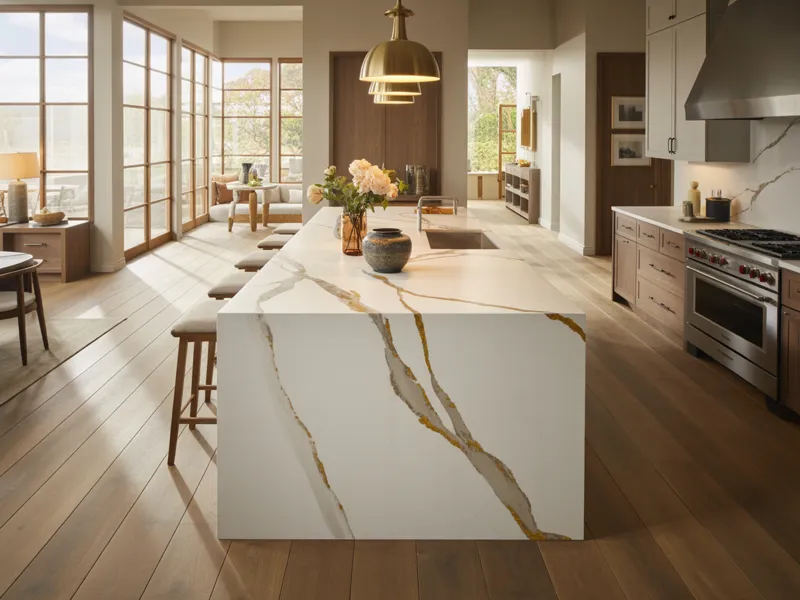
Waterfall Countertops: What to Know Before You Build One

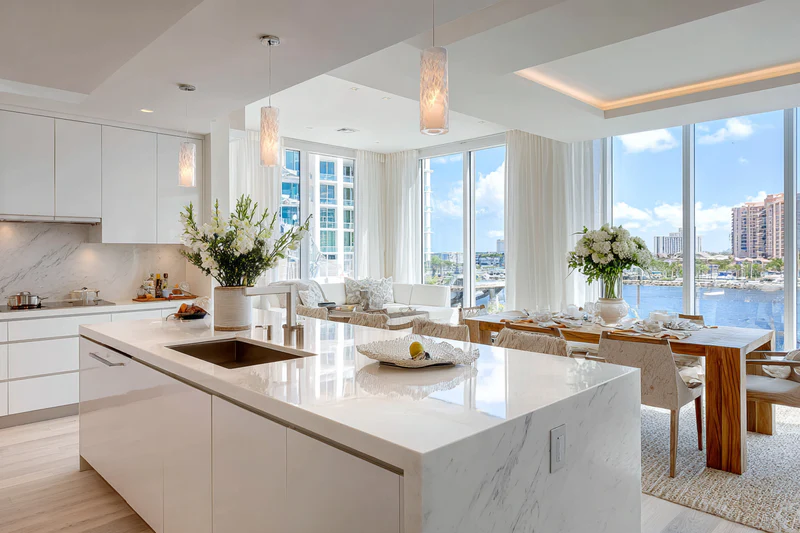
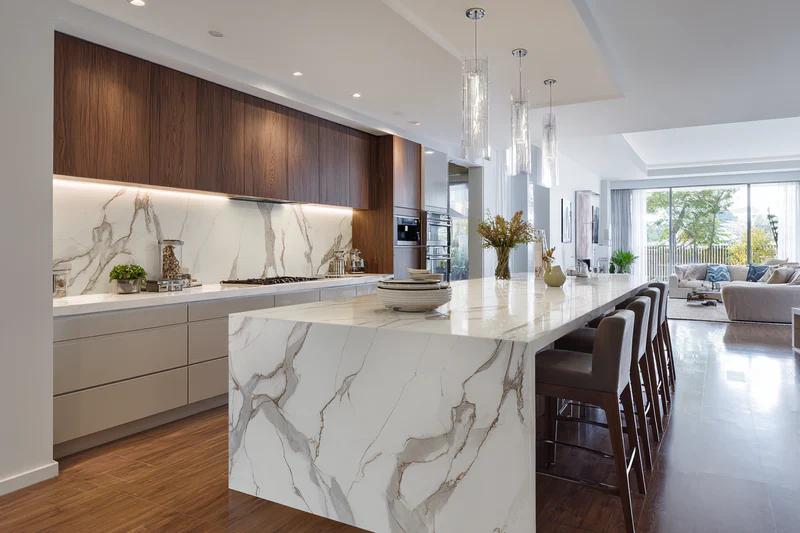
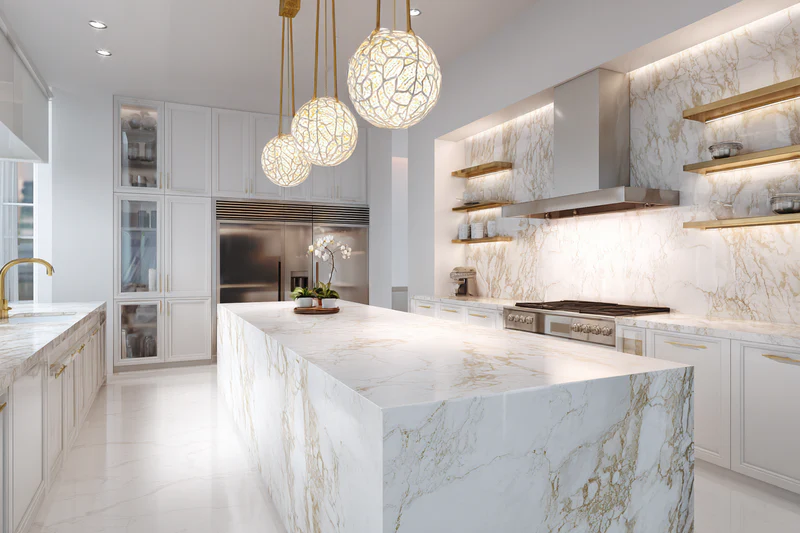
A waterfall countertop is a countertop that turns 90 degrees at the end and runs straight down to the floor, so the stone covers the side of the island or cabinet instead of stopping at the edge. The top and the side meet at a mitered joint, and when the veining is matched across that joint, the slab looks like one folded piece.
Waterfall countertops are most common on kitchen islands, and quartz is a natural fit because its pattern is consistent and it needs no sealing. This guide explains how a waterfall island is built, the choices you will make, and what adds to the cost. For the bigger picture on shaping your countertops, see our quartz countertop design guide.
What Is a Waterfall Countertop?
On a standard island, the countertop sits on top of the cabinets and the ends are finished with cabinet panels. On a waterfall island, one or both ends are finished with a panel of the same quartz, cut from the same slab or a matching slab.
The top and the end panel are each cut at 45 degrees where they meet. When joined, the two cut faces form a square corner with no visible slab thickness, which is what makes the stone look solid. That joint is called a miter, and it is the single most important detail of the job. Our edge profiles guide covers the mitered edge alongside the other options.
Single vs Double Waterfall Island
- Single waterfall: one end drops to the floor, usually the end you see first when you walk in. The other end meets a wall, a cabinet or a standard end panel.
- Double waterfall: both ends drop to the floor, framing the island. It takes more material and two matched miters.
- Waterfall on a peninsula or bar: the same idea applied where a counter ends in open floor space.
A double waterfall makes the island read as a solid block, which works well in open-plan homes where the island is seen from the living area.
Vein Matching: The Detail That Makes or Breaks a Waterfall
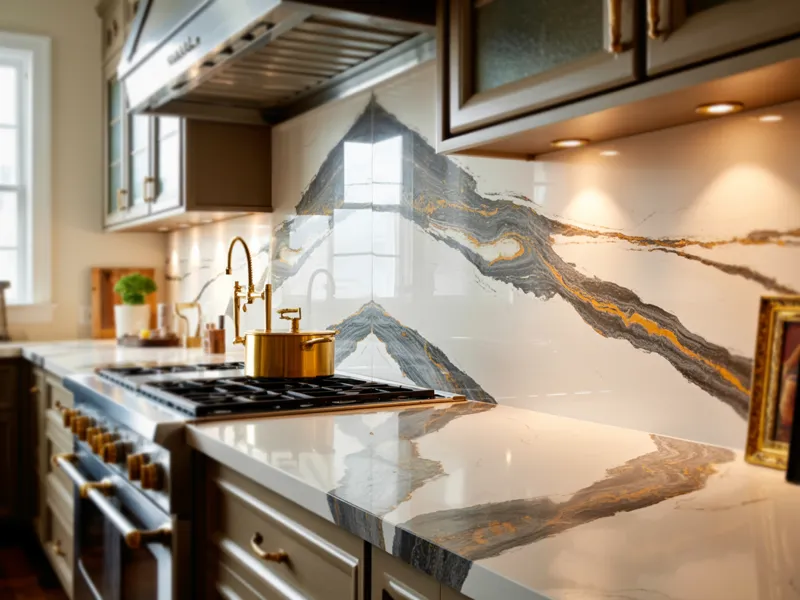
With a solid or speckled quartz, the miter is almost invisible. With a veined quartz, the veins on the top need to continue down the side. That takes planning before any cut is made:
- The layout is planned on the actual slab so the end panel comes from the section right next to the top.
- Vein direction is set so veins run over the edge rather than stopping at it.
- Extra material is often needed so the fabricator can choose the best section of the slab.
Bold-veined whites such as Cambria Brittanicca or MSI Calacatta Laza make the most dramatic waterfalls and demand the most careful matching. Softer patterns such as Caesarstone Frosty Carrina are more forgiving. See our white quartz countertops guide for how these whites differ.
Slab Size and Waterfall Island Layout
Slab size limits how long an island can run before it needs a seam, and a waterfall uses more of the slab than a flat top. Cambria, for example, lists a jumbo slab of 132 by 65.5 inches. A long island with two waterfall ends may need a second slab, and on veined quartz, both slabs should come from the same batch.
Plan these points early:
- Overhang for seating: the waterfall end supports the top, but a seating overhang along the side may still need support.
- Thickness: 3 cm is common for islands; a thinner slab can be mitered to look thicker. Our thickness guide explains the trade-offs.
- Outlets: many kitchens need an outlet on the island. It can go in the waterfall panel or the cabinet side, so decide before templating.
- Floor: the panel sits on the finished floor, so the floor should be installed and level before the island is templated.
How Much Do Waterfall Countertops Cost?
A waterfall costs more than a standard island top, and the price depends on your specific project. The main drivers are:
- Extra material for one or two end panels, plus any extra needed for vein matching.
- Miter fabrication and polishing of the joint.
- The quartz you choose: bold marble looks usually cost more than solids.
- Single or double waterfall, island length, and whether a second slab is needed.
- Installation: heavy panels must be set plumb and secured.
Use our quote calculator for a starting number, then get an exact price at a free in-home estimate. The quartz countertops cost guide covers every cost factor.
Waterfall Countertop Pros and Cons
Pros
- Makes the island a clear focal point.
- Protects the island ends from mop water, vacuum bumps and kicked shoes.
- Quartz needs no sealing, so the vertical panel is as easy to clean as the top.
Cons
- Costs more than a standard top and uses more material.
- A poorly matched miter shows on veined quartz.
- You lose the option of stools or cabinet doors on a waterfall end.
- The panel can chip if hit hard at the corner. Quartz warranties exclude impact damage, so a softly eased corner is worth considering in busy homes.
Are Waterfall Countertops Going Out of Style?
Waterfall islands remain a common request, especially in modern and transitional homes. What has changed is the pattern choice: many homeowners now pair a waterfall with soft or warm veining rather than stark contrast, and some use a waterfall on only one end. A waterfall in a pattern you like for its own sake will date more slowly than one chosen to follow a trend.
Waterfall Countertops in South Florida Homes
In new builds and remodels from Jupiter to Miami, waterfall islands suit the open floor plans common here. Two local points: in condos, check with your building before a delivery of heavy slabs, since many associations set rules for elevators and work hours; and keep indoor quartz inside, because standard quartz warranties exclude outdoor use. For a waterfall on a lanai or poolside kitchen, see our outdoor countertops page for suitable materials. Our kitchen and bath countertops page explains how we template, fabricate and install.
Frequently Asked Questions
What is a waterfall countertop?
A waterfall countertop continues at a 90-degree angle down the end of an island or cabinet to the floor. The top and side are joined with a mitered 45-degree joint, and on veined quartz the veins are matched so the stone looks like one folded piece.
How much extra is a waterfall countertop?
It depends on the project. Cost rises with the extra material for the end panels, the miter fabrication, the quartz you choose, whether it is a single or double waterfall, and whether a second slab is needed. Use a quote calculator for a starting number and get an in-home estimate for an exact price.
Are waterfall countertops going out of style?
Waterfall islands are still widely requested, especially in modern and transitional kitchens. Many homeowners now choose softer or warmer veining and sometimes a waterfall on only one end.
Can you add a waterfall to an existing countertop?
Sometimes, but it is difficult. The top edge must be cut to a 45-degree miter and the new panel must match the existing color and veining, which is rarely possible with an older slab. Most waterfalls are planned with a new top.
Is quartz good for a waterfall island?
Yes. Quartz is consistent in color, needs no sealing and cleans easily on vertical surfaces. Choose the pattern with vein matching in mind: solids and soft veining hide the miter, while bold veining needs careful layout.
Planning a Waterfall Island?
We template, fabricate and install waterfall islands with our own team. Book a free in-home estimate to talk through slab choice, vein matching and layout, or visit our Boca Raton showroom. Call (720) 324-1436.
Book a Free In-Home Estimate