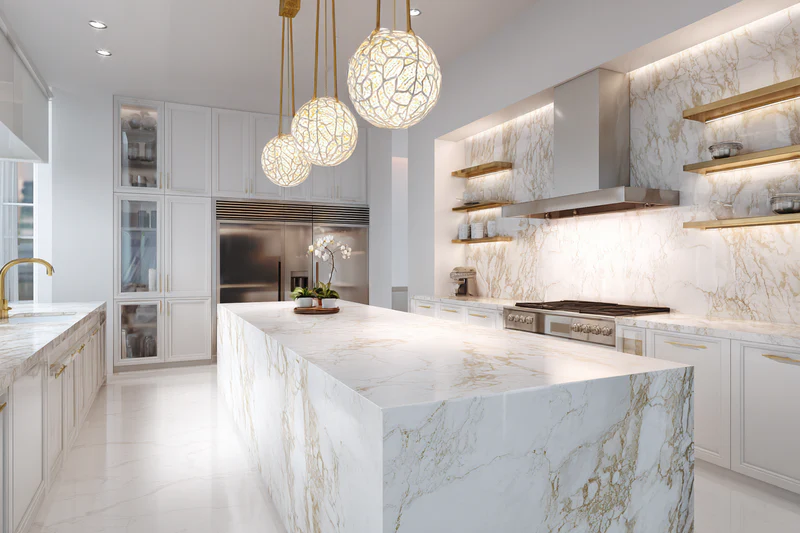

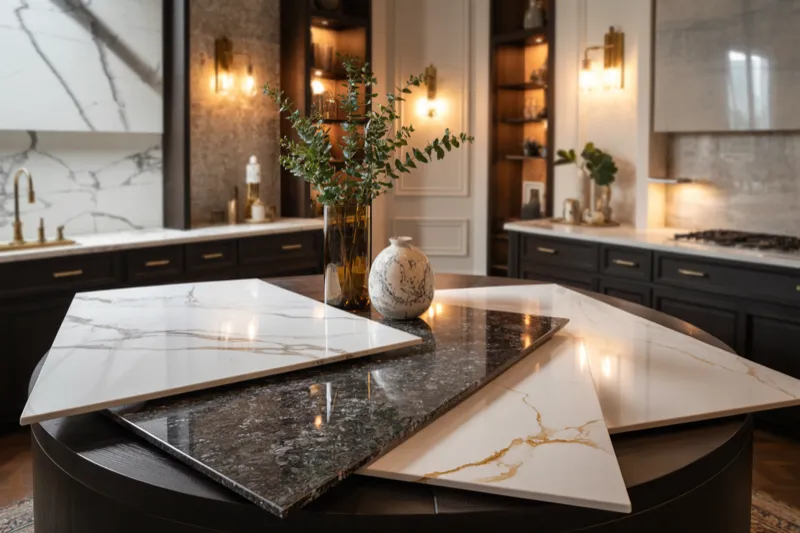
Choosing the right countertop material is one of the most important decisions you will make during a kitchen or bathroom renovation. It affects the look of your space, how much maintenance you will deal with for years to come, how well the surface handles your cooking habits, and — in South Florida — how the material performs under relentless humidity, salt air, and intense UV exposure. Get it right and you will love your countertops for decades. Get it wrong and you will be dealing with stains, etching, and costly repairs.
The four most popular premium countertop materials are quartz, granite, marble, and quartzite. Each one brings distinct advantages, drawbacks, and price points. Each one performs differently depending on where it is installed and how it is used. This comprehensive guide compares all four materials across every factor that matters — durability, maintenance, appearance, cost, heat resistance, stain resistance, and suitability for specific rooms — so you can make a confident decision for your South Florida home.
At Griffin Quartz, we fabricate and install all four of these materials at our Boca Raton facility. We work with homeowners across South Florida every day, and we know from firsthand experience which materials excel in our unique coastal climate. Whether you are remodeling a Boca Raton kitchen, upgrading a Fort Lauderdale bathroom, or building an outdoor kitchen in Palm Beach, this guide will help you find the perfect surface. For an even deeper dive into engineered quartz specifically, see our complete guide to quartz countertops.
Quick Comparison Table: Quartz vs Granite vs Marble vs Quartzite
Before we explore each material in detail, this side-by-side comparison table summarizes how all four materials stack up across the most important factors. Use it as a quick reference, then read on for the full analysis.
| Feature | Quartz | Granite | Marble | Quartzite |
|---|---|---|---|---|
| Origin | Engineered (factory) | Natural igneous rock | Natural metamorphic rock | Natural metamorphic rock |
| Composition | 90-95% quartz + resins | Feldspar, mica, quartz | Recrystallized calcite | Fused sandstone (quartz) |
| Porosity | Non-porous | Porous | Highly porous | Slightly porous |
| Sealing Required | Never | Every 1-2 years | Every 6-12 months | Every 1-2 years |
| Heat Resistance | Moderate (use trivets) | Excellent | Good | Excellent |
| Scratch Resistance | Very good (7 Mohs) | Good (6-6.5 Mohs) | Poor (3-5 Mohs) | Excellent (7 Mohs) |
| Stain Resistance | Excellent | Good (when sealed) | Poor | Good (when sealed) |
| UV Resistance | Poor (can yellow) | Excellent | Good | Excellent |
| Maintenance Level | Virtually none | Low to moderate | High | Low to moderate |
| Cost (South Florida) | $50-$120/sq ft | $45-$150/sq ft | $60-$200/sq ft | $70-$200+/sq ft |
| Best Applications | Kitchens, bathrooms, busy homes | Kitchens, outdoor, traditional homes | Bathrooms, accents, low-traffic areas | Kitchens, outdoor, luxury homes |
Now let us dive deeper into each material so you understand exactly what you are getting.
Quartz Countertops: The Low-Maintenance Champion
Quartz countertops are engineered stone, manufactured in a factory by combining approximately 90 to 95 percent ground natural quartz crystals with 5 to 10 percent polymer resins, pigments, and binding agents. The mixture is pressed under intense vibration and pressure, then cured at high temperatures. The result is a dense, non-porous slab with consistent color and pattern throughout.
Quartz has become the most popular countertop material in the United States for good reason. It combines the beauty of natural stone with the practicality of an engineered surface. Major brands include Cambria, Silestone by Cosentino, Caesarstone, and MSI, each offering hundreds of colors ranging from solid whites to designs that realistically mimic Calacatta marble, granite, and concrete.
Quartz Pros
- Zero maintenance — never needs sealing, clean with soap and water
- Non-porous — resists bacteria, mold, and stains without any treatment
- Consistent appearance — every slab matches, ideal for large projects
- Huge color selection — hundreds of manufactured colors and patterns
- Very hard — approximately 7 on the Mohs hardness scale
- Excellent stain resistance — wine, coffee, oil, and citrus cannot penetrate the surface
- Humidity resistant — perfect for South Florida's coastal climate
Quartz Cons
- Moderate heat resistance — can be damaged by temperatures above 300 degrees Fahrenheit, always use trivets
- UV sensitive — can yellow or discolor with prolonged direct sunlight, not ideal for uncovered outdoor use
- Manufactured appearance — even the best marble-look quartz does not perfectly replicate natural stone up close
- Cannot be repaired easily — deep chips or cracks often require professional repair or slab replacement
Quartz is the ideal material for homeowners who want a beautiful, durable surface without ongoing maintenance. It dominates in indoor kitchens, bathrooms, and busy family homes throughout South Florida. For a complete deep dive, read our complete guide to quartz countertops, and see our quartz countertops service page for project details.
Granite Countertops: The Natural Classic
Granite is a natural igneous rock formed by the slow crystallization of magma deep beneath the Earth's surface. It is composed primarily of feldspar, mica, and quartz, with the mineral composition creating each slab's unique pattern of speckles, veins, and color variations. Granite has been a premium countertop material for decades and remains one of the most popular choices for traditional, Mediterranean, and transitional South Florida homes.
Every granite slab is one of a kind. The swirls of cream, black, gold, blue, and red that run through granite slabs are geological signatures millions of years in the making. This natural uniqueness is a major part of granite's appeal — your countertop will be unlike any other in the world.
Granite Pros
- Excellent heat resistance — can handle hot pots and pans directly from the stove or oven
- Naturally unique — no two slabs are identical, each installation is one of a kind
- Very hard — 6 to 6.5 on the Mohs hardness scale, highly durable for everyday use
- UV resistant — will not yellow or discolor in sunlight, suitable for outdoor use
- Wide price range — options from budget-friendly to ultra-premium
- Proven track record — granite has been used in countertops for decades with excellent longevity
- Adds resale value — granite countertops are universally recognized as a premium upgrade
Granite Cons
- Porous — requires sealing every one to two years to prevent stains and moisture absorption
- Can stain — wine, oil, and acidic substances can leave marks if sealer has worn down
- Slab variation — the slab you see online may look different from the one delivered; always select in person
- Can chip — edges are somewhat susceptible to chipping from heavy impacts
- Seams are visible — joints between slabs are harder to hide than with quartz
Granite remains a strong choice for homeowners who value natural beauty, heat resistance, and a classic aesthetic. It is particularly popular in South Florida's Mediterranean-style and traditional homes, where its warm earth tones complement tile roofs, terracotta floors, and tropical landscaping. In our humid climate, the key is staying on top of sealing to prevent moisture-related issues. Visit our granite countertops page for more information on our granite fabrication and installation services.
Marble Countertops: Timeless Elegance, High Maintenance
Marble is a natural metamorphic rock formed when limestone is subjected to extreme heat and pressure over millions of years. This process recrystallizes the calcite in limestone, creating the flowing veins and luminous translucency that have made marble one of the most prized building materials in human history. From the Taj Mahal to the Lincoln Memorial, marble has symbolized luxury and refinement for centuries.
The most sought-after marble varieties for countertops include Calacatta (bold, dramatic veining on a white background), Carrara (softer gray veining on a lighter base, more affordable), and Statuario (striking gray and gold veining, extremely rare and expensive). Each variety offers a distinct personality, and the natural veining patterns ensure that every slab is a unique work of geological art.
Marble Pros
- Unmatched natural beauty — the veining, depth, and luminosity of marble cannot be replicated by any engineered material
- Cool surface temperature — marble stays naturally cool, making it ideal for pastry work and baking
- Timeless aesthetic — marble never goes out of style and suits everything from classic to contemporary design
- Increases home value — marble countertops are perceived as ultra-premium by buyers
- Develops a patina — some homeowners appreciate how marble softens and ages gracefully over time
Marble Cons
- Soft and scratch-prone — marble rates only 3 to 5 on the Mohs hardness scale, making it susceptible to scratches from knives and abrasive materials
- Etches from acid — lemon juice, vinegar, tomato sauce, wine, and even some cleaning products will leave dull marks (etching) on the surface
- Highly porous — stains easily from oils, colored liquids, and food if not sealed properly
- Requires frequent sealing — needs resealing every 6 to 12 months, more often in humid climates
- Expensive — premium varieties like Calacatta and Statuario can cost $150 to $200+ per square foot installed
- High maintenance — requires pH-neutral cleaners, immediate spill cleanup, and careful daily use
Marble is best suited for low-traffic areas, bathroom vanities, decorative accents, and pastry stations rather than heavy-use kitchen countertops. In South Florida, marble requires extra vigilance because our high humidity accelerates sealer breakdown and increases the risk of moisture-related staining. If you love the look of marble but want something more practical, marble-look quartz countertops offer an increasingly realistic alternative. Learn more on our marble countertops service page.
Quartzite Countertops: The Natural Powerhouse
Quartzite is a natural metamorphic rock formed when sandstone is subjected to extreme heat and pressure deep within the Earth's crust. This geological process fuses the sand grains together into one of the hardest natural stones available, rating a solid 7 on the Mohs hardness scale — harder than granite and dramatically harder than marble. Despite the similar name, quartzite is completely different from engineered quartz.
Quartzite combines the best qualities of natural stone beauty with exceptional durability. Popular varieties include Taj Mahal (warm gold and cream tones), Sea Pearl (cool grays with dramatic movement), Fantasy Brown (brown and gray veining), and Super White (a bright white stone often confused with marble). Each slab is unique, with organic veining patterns that tell a story of geological forces.
Quartzite Pros
- Extremely hard — 7 on the Mohs scale, resistant to scratches from knives and abrasives
- Excellent heat resistance — handles hot pots and pans directly without damage
- UV resistant — will not yellow or fade in direct sunlight, ideal for outdoor installations
- Natural beauty — each slab is one of a kind with organic veining and depth
- More durable than marble — offers a marble-like aesthetic with significantly better hardness and durability
- Long lifespan — properly maintained quartzite can last a lifetime
Quartzite Cons
- Slightly porous — requires sealing every one to two years to prevent staining
- Higher cost — typically more expensive than quartz and granite, ranging from $70 to $200+ per square foot
- Slab variation — significant variation between slabs means you must select each slab in person
- Beware of mislabeling — some dealers sell soft marble or dolomite as "quartzite," always verify hardness
- Limited color range — colors are determined by nature, so options are narrower than engineered quartz
Quartzite is an outstanding choice for homeowners who want natural stone beauty with better durability than marble and better UV resistance than quartz. It excels in outdoor kitchens, luxury custom homes, and any installation exposed to South Florida's intense sunlight. For our full comparison of quartz and quartzite, read our dedicated quartz vs quartzite guide, or visit our quartzite countertops service page.
Quartz vs Granite: Head-to-Head Comparison
The granite vs quartz countertops debate is the most common question we hear at Griffin Quartz. These two materials dominate the kitchen countertop market, and the right choice depends on your priorities.
Durability
Both are highly durable, but they excel in different areas. Granite is harder when it comes to heat — you can place a 500-degree skillet directly on granite without flinching. Quartz cannot handle that kind of direct heat due to its resin binders. However, quartz is more resistant to staining because its non-porous surface gives liquids nowhere to go. Granite's pores can absorb wine, oil, and coffee if the sealer has worn down.
Maintenance
This is where quartz pulls ahead decisively. Quartz requires zero maintenance beyond wiping with soap and water. Granite needs sealing every one to two years — a step that South Florida's humidity makes even more critical, as moisture accelerates sealer breakdown. Skip the sealing and your granite is vulnerable to staining. For busy homeowners, quartz's maintenance-free nature is a significant practical advantage.
Aesthetics
Granite offers unique natural beauty — every slab has its own mineral patterns, sparkle, and depth. Quartz offers consistency and an enormous range of colors, including realistic marble and granite looks. If you want a one-of-a-kind natural surface, granite wins. If you need multiple slabs that match perfectly, quartz wins.
Cost
The initial price range overlaps significantly. Entry-level granite and quartz both start around $45 to $55 per square foot installed in South Florida. Premium options for both can exceed $120 per square foot. However, when you factor in granite's ongoing sealing costs ($200 to $400 every one to two years over decades), quartz has a lower total cost of ownership.
South Florida Climate
In our humid, salt-air environment, quartz has a practical edge for indoor installations. Its non-porous surface is impervious to humidity, while granite's sealer can break down faster in our climate. For outdoor kitchens, however, granite wins because it handles UV exposure without yellowing. For our complete Fort Lauderdale-specific comparison, see quartz vs granite in Fort Lauderdale.
Quartz vs Marble: Head-to-Head Comparison
The quartz vs marble countertops comparison often comes down to a battle between practicality and passion. Marble is what many homeowners dream of. Quartz is what many homeowners ultimately choose when they learn the realities of marble ownership.
Durability
Quartz wins this category by a wide margin. At approximately 7 on the Mohs hardness scale, quartz is dramatically harder than marble, which rates only 3 to 5. Marble scratches from knives, chips from impacts, and etches from common acids like lemon juice, vinegar, and tomato sauce. Quartz resists all of these without issue. If your kitchen sees daily cooking, quartz is the far more practical surface.
Aesthetics
This is marble's domain. The natural depth, translucency, and flowing veins of genuine Calacatta or Statuario marble are breathtaking. No engineered material has perfectly replicated the way light passes through marble's crystalline structure. That said, the most realistic marble-look quartz countertops from brands like Cambria and Silestone are stunningly close. From across a room, many guests cannot tell the difference. The gap between marble and marble-look quartz has narrowed significantly in recent years.
Maintenance
Quartz wins by a mile. Marble needs sealing every 6 to 12 months, immediate cleanup of acidic spills, pH-neutral cleaners only, and careful daily use. A glass of red wine left on unsealed marble can leave a permanent ring. Quartz needs nothing — wipe it down and forget about it. In South Florida's humid environment, marble's frequent resealing becomes an even more pressing commitment.
Cost
Surprisingly, mid-range marble and mid-range quartz overlap in the $70 to $100 per square foot range. Entry-level Carrara marble can be affordable, while premium Calacatta commands prices north of $150 per square foot. When you add marble's ongoing maintenance costs — sealing, specialty cleaners, potential repair of etching and stains — quartz offers better long-term value for most budgets.
The Compromise: Marble-Look Quartz
For many South Florida homeowners, the best solution is a marble-look quartz countertop. These engineered slabs feature the bold veining and warm white tones of Calacatta or Carrara marble with the zero-maintenance durability of quartz. Brands like Cambria offer collections like Brittanicca and Ella that are remarkably realistic. You get the marble aesthetic for your kitchen island without worrying about etching every time you squeeze a lemon. It is genuinely the best of both worlds.
Quartz vs Quartzite: Head-to-Head Comparison
The quartz vs quartzite comparison confuses many homeowners because the names are so similar. These are fundamentally different materials. Quartz is engineered in a factory. Quartzite is a natural rock quarried from the Earth. Their performance profiles diverge significantly.
The key differences come down to three areas. Maintenance: quartz never needs sealing, quartzite needs sealing every one to two years. UV resistance: quartzite handles direct sunlight beautifully, quartz can yellow outdoors. Heat resistance: quartzite handles hot pots directly, quartz cannot.
If you are choosing between these two, the decision often comes down to whether your installation is indoor or outdoor. For indoor kitchens where low maintenance matters most, quartz is typically the smarter pick. For outdoor kitchens, pool bars, or any area with heavy sun exposure, quartzite is the better material.
We have written a comprehensive, dedicated comparison covering every aspect of this decision. Read our full quartz vs quartzite guide for the complete deep dive.
Which Material Is Best for Kitchens?
The kitchen is where countertop material choice matters most. It is the highest-traffic surface in your home, exposed to heat, moisture, sharp objects, acidic foods, and heavy daily use. All four materials can work in a kitchen, but each comes with tradeoffs.
Quartz leads for most kitchen applications. Its non-porous surface means you never have to worry about sealing, staining, or bacteria growth. Spill red wine, olive oil, or lemon juice — wipe it up whenever you get around to it. Quartz's consistency also makes it ideal for large kitchen islands that require multiple slabs to look seamless. For busy South Florida families, quartz is the practical frontrunner.
Granite is the best choice for serious home cooks who routinely move hot pots and pans from the stove directly to the counter. Granite's superior heat resistance gives peace of mind that quartz cannot match. It is also the material of choice for homeowners who want natural stone character in a traditional or Mediterranean kitchen — a style that dominates many South Florida neighborhoods.
Marble is best reserved for accent areas in the kitchen — a pastry station, a decorative backsplash, or a small prep area that does not see heavy daily use. Using marble as your primary kitchen countertop material is a commitment to ongoing maintenance. If you love marble's look for your main counters, strongly consider marble-look quartz as your primary surface with a genuine marble accent piece for your baking area.
Quartzite offers luxury natural stone beauty with better kitchen performance than marble. It handles heat excellently, resists scratches better than granite, and provides the one-of-a-kind natural veining that engineered materials cannot replicate. The tradeoff is the annual sealing commitment and higher price point. For high-end custom South Florida kitchens where budget is not the primary concern, quartzite delivers a showstopping result.
Which Material Is Best for Bathrooms?
Bathrooms present unique challenges: constant moisture exposure, humidity from showers and baths, and frequent contact with personal care products that may contain acids or dyes. In South Florida, where ambient humidity already hovers at 75 to 80 percent year-round, bathroom countertop material choice is especially important.
Quartz is the ideal bathroom countertop material. Its completely non-porous surface means humidity, splashed water, and bathroom products cannot penetrate the surface. There is zero risk of mold or mildew growing within the countertop itself. Hair dyes, nail polish remover, and skincare products can be wiped away without leaving a trace. For South Florida bathrooms — from master suites to guest baths — quartz is the safest, lowest-maintenance choice. See our bathroom vanity countertops page for options.
Marble works in low-traffic guest bathrooms where the surface will not see heavy daily use. A Carrara marble vanity in a powder room adds genuine luxury and will not take the kind of beating a master bathroom counter endures. Just be aware that acidic toiletries, perfumes, and hair products can etch marble if left sitting on the surface.
Granite performs well in bathrooms but needs consistent sealing to handle the constant moisture exposure. In a South Florida master bathroom with daily shower steam, granite's sealer can break down faster than in a kitchen. Stay on top of annual sealing and granite performs admirably.
Quartzite works in bathrooms with the same sealing caveat as granite. Its hardness and natural beauty make it a premium option, but the moisture-heavy bathroom environment means you must be diligent about maintaining the seal.
Which Material Is Best for Outdoor Use in South Florida?
South Florida's outdoor living culture means outdoor kitchens, pool bars, and patio entertaining areas are nearly as common as indoor kitchens. But our climate is brutal on countertop materials. Intense UV radiation, afternoon thunderstorms, salt air from the coast, and temperatures that frequently exceed 90 degrees create an environment where only certain materials survive.
Quartzite is the premium choice for outdoor countertops in South Florida. It is UV resistant (will not yellow or fade), heat resistant (can handle the Florida sun beating down all day), extremely hard (resists scratching and chipping), and naturally beautiful. A properly sealed quartzite outdoor kitchen counter will look stunning for decades. It is the material we most often recommend for uncovered outdoor installations.
Granite is the proven workhorse for outdoor use. It handles UV exposure, heat, rain, and temperature fluctuations without issue. Granite outdoor kitchens have a long track record in South Florida, and the material's wide price range makes it accessible for more budgets. The key is consistent sealing — outdoor granite in South Florida needs resealing at least once a year due to the intense weather exposure.
Quartz should be avoided for uncovered outdoor installations. The polymer resins that bind quartz can yellow, discolor, and degrade under prolonged UV exposure. South Florida gets some of the most intense sunlight in the continental United States, and even a partially covered outdoor quartz counter can develop noticeable yellowing within a few years. If your outdoor kitchen has a fully enclosed, UV-blocking cover, quartz may work. Otherwise, choose quartzite or granite.
Marble is not recommended for outdoor use. Its softness, porosity, and susceptibility to etching make it poorly suited for the harsh outdoor environment. Rain, bird droppings, tree sap, and Florida's acidic afternoon storms will damage marble quickly.
Cost Comparison: All Four Materials in South Florida
Price is always a factor, and South Florida countertop pricing reflects both the material cost and the specialized fabrication and installation required. Here is what to expect across all four materials in 2026. For a more detailed breakdown of quartz pricing, see our quartz countertops cost guide.
| Material | Entry Level | Mid Range | Premium |
|---|---|---|---|
| Quartz | $50-$65/sq ft | $65-$90/sq ft | $90-$120+/sq ft |
| Granite | $45-$65/sq ft | $65-$100/sq ft | $100-$150+/sq ft |
| Marble | $60-$80/sq ft | $80-$130/sq ft | $130-$200+/sq ft |
| Quartzite | $70-$90/sq ft | $90-$140/sq ft | $140-$200+/sq ft |
Prices include fabrication, standard edge profile, and professional installation. Complex layouts, premium edge profiles, and large cutouts (undermount sinks, cooktops) may add additional cost.
Total Cost of Ownership Over 15 Years
The purchase price is only part of the equation. Ongoing maintenance costs change the long-term picture significantly.
- Quartz: $0 additional maintenance cost. No sealing, no specialty cleaners, no professional care needed. Your total cost is the installation price.
- Granite: Professional sealing every 1-2 years at $200-$400 per application, plus stone-safe cleaners. Over 15 years, add approximately $1,500 to $3,000 to the installation cost.
- Marble: Professional sealing every 6-12 months at $200-$400 per application, specialty cleaners, and potential professional polishing to address etching. Over 15 years, add approximately $3,000 to $6,000 or more to the installation cost.
- Quartzite: Similar to granite — professional sealing every 1-2 years at $200-$400 per application. Over 15 years, add approximately $1,500 to $3,000.
When you combine initial cost with lifetime maintenance, quartz consistently delivers the best long-term value for indoor installations. Use our online quote calculator to estimate your specific project cost, or request a free in-home estimate.
How South Florida's Climate Affects Your Decision
Living in South Florida is not like living in the Midwest, the Northeast, or even other parts of the Southeast. Our climate creates specific conditions that directly affect how countertop materials perform over time. Here is what to consider.
Humidity and Salt Air
South Florida averages 75 to 80 percent humidity year-round, with coastal areas like Boca Raton, Fort Lauderdale, and Palm Beach experiencing constant salt-air exposure. This combination accelerates the breakdown of stone sealers on granite, marble, and quartzite. Where a homeowner in dry Colorado might seal their granite every two years, a South Florida homeowner should plan on annual sealing. Quartz is completely unaffected by humidity and salt air — a meaningful advantage in our coastal environment.
UV Exposure
South Florida receives some of the highest UV radiation in the continental United States. If your kitchen has large windows, a sunroom, or a counter that sits in direct afternoon sunlight, UV resistance matters. Quartz can yellow near sun-facing windows over time. Granite, marble, and quartzite are all more UV-stable than quartz. For any outdoor or sun-exposed installation, this is a critical consideration.
Hurricane Season and Weather
Outdoor countertops in South Florida must withstand intense rain, potential storm debris, and dramatic temperature swings during hurricane season. Quartzite and granite are the most resilient in these conditions. Their natural stone composition handles moisture, heat, and physical impact better than engineered materials in an outdoor setting.
Indoor Air Conditioning
Most South Florida homes run air conditioning year-round, creating a controlled indoor environment. In these conditioned spaces, all four materials perform well. The climate advantages and disadvantages apply primarily to outdoor installations, areas near windows, and spaces with poor climate control.
Making Your Final Decision: Material Selection Guide
After comparing all four materials, here is a simple decision framework to help you narrow your choice.
Choose quartz if:
- Low maintenance is your highest priority
- You want zero sealing, zero specialty cleaners, and zero worry about stains
- Your countertops will be indoors and not exposed to intense direct sunlight
- You want consistent color matching across a large kitchen island
- You have a busy household with kids, entertaining, and daily cooking
- You want the look of marble without any of the maintenance — choose a marble-look quartz
Choose granite if:
- You love natural stone character and do not mind that each slab is unique
- Heat resistance is important — you place hot pots directly on the counter
- You are building an outdoor kitchen on a moderate budget
- You want a proven, classic material for a traditional or Mediterranean South Florida home
- You are comfortable sealing your countertops every one to two years
Choose marble if:
- Beauty is your absolute top priority, even at the expense of practicality
- The installation is a low-traffic area — bathroom vanity, powder room, or decorative accent
- You are a baker who wants marble's naturally cool surface for pastry work
- You appreciate the patina that marble develops over time and see it as character
- You understand and accept the ongoing maintenance commitment
Choose quartzite if:
- You want natural stone beauty that is significantly harder and more durable than marble
- Your installation includes outdoor areas exposed to South Florida sun
- Heat resistance matters — you cook frequently with heavy, hot cookware
- You want a truly unique, statement-making countertop for a luxury home
- You are comfortable with periodic sealing and a higher price point
Still not sure? The best way to decide is to see and touch the materials in person. Visit our Boca Raton showroom to compare samples side by side, or browse our full countertop materials page to explore every option we offer. You can also learn about proper care for any surface in our countertop cleaning guide.
Frequently Asked Questions
What is the most durable countertop material?
Quartzite and quartz are the most durable countertop materials overall. Quartzite ranks 7 on the Mohs hardness scale and offers superior heat and scratch resistance. Quartz also rates around 7 on the Mohs scale and adds excellent stain resistance due to its non-porous surface. Granite is close behind at 6 to 6.5 Mohs. Marble is the softest of the four at 3 to 5 Mohs and scratches and etches more easily.
Is granite or quartz better for kitchen countertops?
Both are excellent for kitchens, but quartz is better for most homeowners due to its zero-maintenance requirements. Quartz is non-porous, never needs sealing, and resists stains from wine, coffee, and cooking oils without any effort. Granite offers superior heat resistance and one-of-a-kind natural beauty, but requires sealing every one to two years and can stain if the sealer wears down. In humid South Florida climates, quartz has a practical advantage because humidity does not affect its non-porous surface.
Is marble worth it for kitchen countertops?
Marble is worth it if you prioritize timeless beauty and are willing to invest in maintenance. Marble is softer than quartz, granite, and quartzite, rating only 3 to 5 on the Mohs hardness scale. It etches from acidic foods like lemon juice and tomato sauce, stains without regular sealing, and scratches more easily. Many homeowners love marble's patina over time, but it is best suited for low-traffic areas, bathroom vanities, or accent surfaces rather than heavy-use kitchen countertops.
What is the difference between quartz and quartzite countertops?
Despite similar names, quartz and quartzite are completely different materials. Quartz is engineered stone made from 90 to 95 percent ground quartz crystals mixed with polymer resins. It is manufactured in a factory, is non-porous, and never needs sealing. Quartzite is 100 percent natural metamorphic rock quarried from the earth. It is slightly porous and requires sealing every one to two years. Quartzite offers superior heat resistance and UV stability, making it better for outdoor use. Quartz offers easier maintenance and more consistent color matching.
Which countertop material is best for outdoor kitchens in Florida?
Quartzite and granite are the best countertop materials for outdoor kitchens in Florida. Both are natural stones that resist UV damage and will not yellow or discolor in direct sunlight. Quartzite is the premium choice due to its extreme hardness and heat resistance. Granite is a more budget-friendly natural stone option. Quartz should be avoided for uncovered outdoor installations because its resin binders can yellow and degrade under prolonged UV exposure. Marble is too soft and porous for outdoor use.
How much do countertops cost in South Florida?
In South Florida, countertop costs vary by material. Quartz ranges from $50 to $120 per square foot installed, granite from $45 to $150 per square foot, marble from $60 to $200 per square foot, and quartzite from $70 to $200 or more per square foot. A typical 40 square foot kitchen countertop project costs between $2,000 and $8,000 or more depending on the material and complexity. These prices include fabrication, installation, and standard edge profiles.
Do granite countertops need to be sealed?
Yes, granite countertops need to be sealed upon installation and resealed every one to two years. Granite is a natural stone with microscopic pores that can absorb liquids if left unprotected. Without proper sealing, granite can stain from wine, oil, coffee, and other common kitchen substances. In South Florida's humid climate, sealer breakdown can accelerate, so some homeowners may need to reseal annually. Quartz is the only countertop material among the four that never requires sealing.
Can I get the look of marble without the maintenance?
Yes. Marble-look quartz countertops have become extremely popular and realistic. Brands like Cambria, Silestone, and Caesarstone offer quartz slabs that mimic the look of Calacatta, Carrara, and Statuario marble with dramatic veining and warm tones. These engineered surfaces give you the marble aesthetic with the zero-maintenance benefits of quartz — no sealing, no etching, and no staining. It is the best of both worlds for homeowners who love marble's beauty but not its upkeep.
Not Sure Which Material Is Right for You?
Choosing between quartz, granite, marble, and quartzite is easier when you can see and touch the materials in person. Visit our Boca Raton showroom or schedule a free in-home consultation with our countertop experts. We will help you find the perfect material for your space, your lifestyle, and your budget. Call (720) 324-1436 or request your free estimate online.
Get FREE Estimate